What is the JAOHL?
What is the JAOHL?
Advancing Occupational Health Across Disciplines: Bridging Cutting-Edge Jurisprudence and Practice with Accessible Legal Education
Currently, the field of occupational health is plagued by challenges deeply rooted in work and life styles, primarily mental health issues and lifestyle-related diseases.
These are “gray zone” issues –problems that cannot be clearly categorized as solely medical conditions or matters of personality.
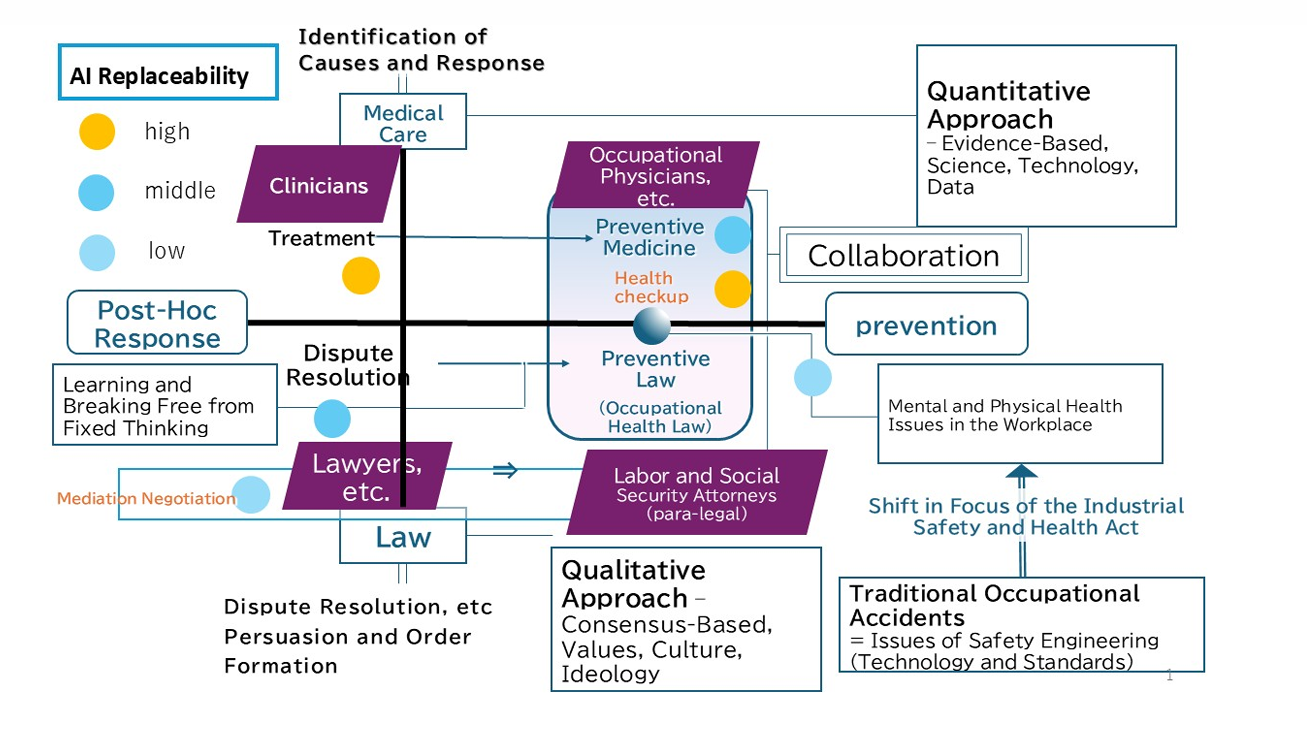
Solving these challenges is difficult within the confines of a single field of expertise; it requires an interdisciplinary approach that considers the workplace, the individual, and the organization. In the field of occupational health, “Law” holds significant meaning because: 1) Law leads the domain (providing standards for occupational health practices), and 2) Legal disputes are prone to occur. More fundamentally, the law’s “power to foster acceptance” (consensus-building) and its “normative nature” (influence on daily behavior) play a crucial role in the prevention of health impairments, post-incident resolution, and health promotion.
This approach aims to emphasize the qualitative approach of law (the ability to adjust values and conflicting interests) in addition to the quantitative approach prioritized by traditional preventive medicine. It can be described as a collaboration between Preventive Medicine and “Preventive Jurisprudence.”
However, merely being “used by the law” will not solve workplace problems. Viewing law as a rigid solid object –adopting an attitude of “it’s the rule, so just follow it” –is simply being subservient to the law and creates harmful side effects. We must understand the intent of those who created the law and the struggles of those who use it, refining our skills and mindset to use it proactively. Furthermore, we must advance toward the creation of law. The ultimate goal of this Society is to increase the number of people who can lead satisfying professional lives. In short, this is the exploration of “Living Law” regarding occupational health and safety.
In this context, the definition of health also needs reviewing. Since satisfying the WHO definition of health (complete physical, mental, and social well-being) is difficult, “health” can be conceived as making choices the individual is convinced of, in consultation with experts.
To this end, we aim to develop “A Legal Theory that Looks at People.” Rather than emphasizing “what must not be done,” we need a stance that suggests “what may be done.”
Specifically:
- We aim to support occupational health through law. In particular, we support problem-solving related to people and organizations (both prevention and post-event response).
- We aim to develop laws with preventive effects.
Coinciding with the launch of the Society, a certification system was also established (Certification titles:Certified Occupational Health Law Specialist / Certified Mental Health Law Specialist). These qualifications are granted to members who have comprehensively learned practical knowledge in related fields, centering on legal affairs, and have acquired the ability to solve workplace problems. We hope that many individuals involved in occupational health will study and challenge themselves to obtain these certifications.
Regarding the effectiveness of the legal education provided by this Society, research funded by the Ministry of Health, Labour and Welfare has already demonstrated that:
- Occupational Health Law Training leads to improved “problem-solving skills in occupationalhealth.”
- Safety and Health Law Training leads to improved “persuasiveness toward management andorganizations” for preventive behavioral change.
Society Overview: Founded in November 2020 and incorporated in November 2021. As of November 2025, there are over 1,200 members. The annual academic conference attracts over 1,100 participants. The Society is characterized by being future-oriented and field-oriented, aiming to achieve “Society 5.0” (a phase emphasizing social problem-solving).
Background of Establishment: Activity Experience and Necessity
- Precursor Activities This Society is based on the experience of the “Occupational Health Law Research Group” (established in 2012; originally the Occupational Health Law Research and Training Center). Led by one of the founders, Professor Takenori Mishiba of the Kindai University Faculty of Law, that group trained approximately 800 students, including occupational physicians, labor and social security attorneys, public health nurses, nurses, counselors, corporate HR representatives, and lawyers. This served as the foundation for the organization launched in 2020.
- Necessity of the Society Solving the many problems arising in today’s occupational health field is difficult for individual specialized fields alone. An interdisciplinary response that looks at the workplace, the individual, and the organization is required.
- Example: An employee whose abilities or values did not match the organization fell mentally and physically unwell and took medical leave. Although clinical symptoms subsided and they wished to return to work, the organization refused the return because the original problems had not improved or surrounding workers showed an “allergic reaction” to the individual, leading to a dispute.
- Example: A supervisor scolded a subordinate for an issue that seemed obvious to the supervisor. The subordinate then took leave or resigned, claiming to have developed a mental disorder. The supervisor’s organizational and legal liability was questioned, leading to cases where the organization became atrophy/fearful of management.
- Example: While the Industrial Safety and Health Act (ISHA) has mandated measures only for chemical substances with identified toxicity, exposure damage from other substances is occurring frequently. In such cases, even if not directly regulated by the ISHA, civil courts often find the employer liable based on outcome responsibility, lacking predictability for businesses.
- Law leads the domain (Law provides the guidelines for occupational health duties).
- Legal disputes are prone to occur (Because the concept of “health” is ambiguous and diverse,the locus of responsibility for health damage often becomes unclear).
- Purpose The main purposes of this Society are:
- To explore appropriate (preventive and post-event) problem-solving strategies regarding occupational health.
- To create a trend of utilizing law preventively.
- To resolve remaining issues within the Industrial Safety and Health Act.
- Philosophy We emphasize support for self-determination based on trial-and-error and dialogue regarding the health of labor and management. As is well known, the WHO defines well-being as physical, mental, and social health. However, in reality, satisfying all of these is difficult. Each worker needs to obtain appropriate information and select their target “health,” including which aspects to prioritize, through trial and error. The importance of supporting self-determination also applies to the organizations that employ and use workers.
To solve these “gray zone” issues, we decided to initiate interdisciplinary academic activities using laws and precedents as material. (Systematic texts and practical books demonstrating the Society’s philosophy include: Commentary on the Industrial Safety and Health Act [ed. Mishiba, Society cooperation], Living Industrial Safety and Health Act [Mishiba, Society cooperation], and Living Occupational Health Law [Mishiba, Society cooperation]).
Why is Law important for Occupational Health? There are two main reasons:
In other words, prevention requires not only data-based technical responses but also the law’s qualitative ability to resolve conflicts, its power of persuasion, and its ability to form organizations and order.
Ultimately, we believe the final goal is to support the “blooming of individuality through work” by both individuals and organizations. This purpose-oriented interdisciplinary approach also prompts a redefinition of knowledge.
International Collaboration
The Japan Association of Occupational Health Law (JAOHL) is a cooperating academic research organization of the Science Council of Japan. We have concluded a Memorandum of Understanding (MoU) with the Society of Occupational Medicine (SOM) in the UK to facilitate regular information exchange.
In 2025, we held an online international conference on occupational safety and health (OSH) regulations in the AI era, in collaboration with Japan’s Ministry of Health, Labour and Welfare (MHLW), EU-OSHA, the UK Health and Safety Executive (HSE), and Germany’s Bau-Berufsgenossenschaft (BG BAU). The report from this conference has been published on the EU-OSHA website:
· EU-OSHA Report:Exploring OSH policy in the AI era – conference report out now